What Is CEDAW General Recommendation No. 39 — and Why It Matters Now
In 2022, the United Nations Committee on the Elimination of Discrimination Against Women made history.
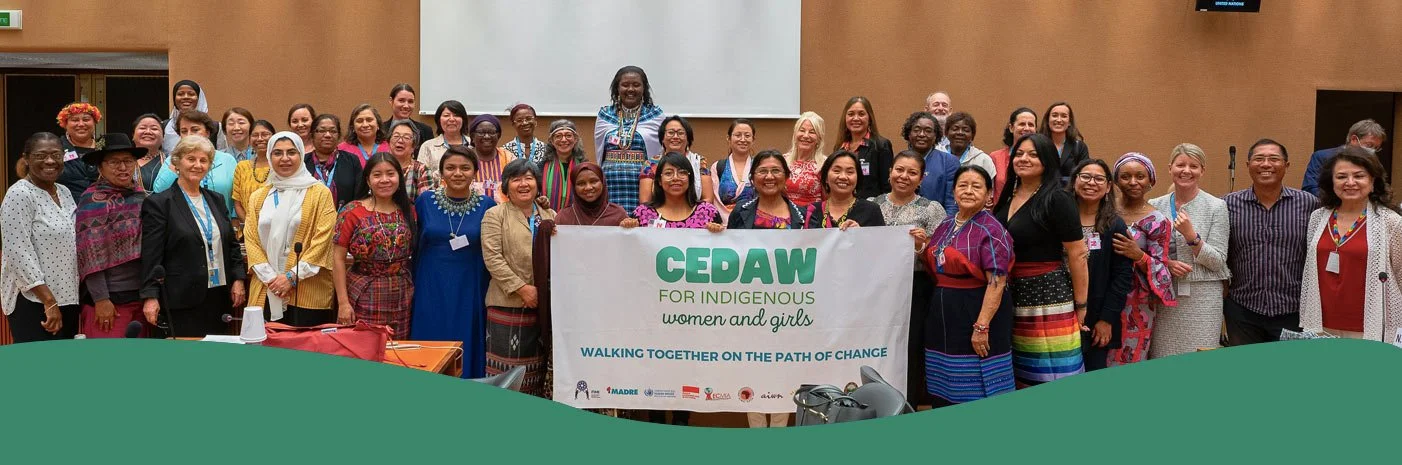
After years of advocacy led by Indigenous women from every corner of the globe, the Committee adopted General Recommendation No. 39 — the first international legal standard dedicated specifically to the rights of Indigenous women and girls.
It recognizes something that Indigenous communities have always known: Indigenous women are not simply "women" in a generic sense, nor simply "Indigenous people" in a generic sense. They are rights-holders with a distinct legal status — as land defenders, spiritual leaders, knowledge keepers, and the backbone of collective governance systems that predate every colonial border.
GR39 names that reality. In international law, that is not a small thing.
So why haven't you heard about it?
Because the United States has never ratified CEDAW.
The U.S. is one of only a handful of countries in the world — and the only high-income democracy — that has not ratified the treaty widely known as the international bill of rights for women. That means that even with GR39 now on the books, Indigenous women in the U.S. have no federal mechanism to invoke its protections.
This is the gap PLUME was built to address.
What GR39 actually says
GR39 is a 46-article document. Here is what matters most for Indigenous women and Tribal Nations:
It recognizes collective rights alongside individual rights. Most international human rights frameworks focus on the individual. GR39 explicitly affirms that Indigenous women hold rights both as individuals and as members of Nations and communities — a distinction that is foundational to Indigenous legal traditions.
It centers Free, Prior and Informed Consent (FPIC). Any decision that affects Indigenous women's lands, territories, resources, or cultural heritage requires their genuine consent — not notification, not consultation after the fact, but consent before action is taken.
It addresses gender-based violence as a structural, not individual, problem. GR39 connects violence against Indigenous women directly to land dispossession, forced assimilation, and the dismantling of Indigenous governance systems. It calls for remedies that address root causes, not just symptoms.
It affirms Indigenous women's spiritual and political authority. The recommendation recognizes that Indigenous women hold specific roles in governance, ceremony, and knowledge transmission — and that protecting those roles is a human rights obligation, not a cultural preference.
It applies to Indigenous women in both tribal and urban contexts. Nearly 70% of Indigenous people in the United States live in urban areas. GR39 is explicit: the rights it recognizes do not disappear when Indigenous women leave their homelands.
What it means that the U.S. hasn't ratified CEDAW
Federal inaction does not have to mean community inaction.
GR39 is already being used — by tribal governments that are incorporating its standards into their own policies, by Indigenous women's organizations that are using it as a framework for advocacy, and by advocates who are bringing it into conversations at the UN Permanent Forum on Indigenous Issues and other international spaces.
The U.S. government's refusal to ratify CEDAW removes one pathway. It does not remove all of them.
Indigenous Nations have always exercised their sovereignty without waiting for federal permission. GR39 offers a legal framework that affirms what Indigenous women already know about their rights — and gives Tribal Nations, Indigenous organizations, and advocates a powerful tool to invoke, regardless of what Washington does or doesn't do.
This is what self-determination looks like in practice.
What PLUME is doing about it
PLUME's campaign Path of the Matriarchs: Advancing GR39 is a national education and mobilization effort with one goal: ensuring that every Indigenous women's organization and Tribal Nation in the United States knows what GR39 says, why it matters, and how to put it to work.
That means:
Plain-language education — factsheets, videos, and webinars that translate a 46-article UN document into something a tribal council can use at its next meeting.
Technical assistance — working directly with Tribal Nations and Indigenous organizations to incorporate GR39 into their governance frameworks, advocacy strategies, and human rights reporting.
Community workshops and national town halls — because the most effective education happens in conversation, not in policy briefs.
International alignment — connecting domestic organizing with global spaces, including the ECMIA 30th Anniversary, COP30, and ongoing UN mechanisms, so that the advocacy happening in communities across the U.S. shapes what happens at the international level, and vice versa.
Why now
The urgency is not abstract.
Indigenous women in the United States face the highest rates of violence of any demographic group. They are murdered at more than ten times the national average in some tribal communities. They are disproportionately affected by environmental destruction, land theft, and the dismantling of tribal governance. They are systematically underrepresented in the decision-making spaces that determine their futures.
GR39 does not solve these problems by itself. No legal document does.
But it gives Indigenous women and their Nations a standard to hold governments and institutions accountable to — one grounded in their own experiences, their own governance traditions, and their own definitions of justice.
That is worth fighting for. That is what PLUME was built to do.
PLUME is leading the Path of the Matriarchs campaign through 2025 and 2026. To learn more, access our GR39 resources, or bring a workshop to your community or organization, visit our Resources page or contact us directly.